Friday, September 10, 2010

The Conversion of Fish Hawk

Bonnie Sue Lewis uses the conversion story of Fish Hawk, a Cayuse Indian, to illustrate the complexity involved in deciding to become a Christian Indian. (To get the whole story, you'll have to read Creating Christian Indians.) Like many other Indians, Fish Hawk made a deathbed conversion.

If Fish Hawk's conversion was like most people's stereotype of deathbed conversions, it would have been a superficial and/or cynical gesture, but this is clearly not the case. Instead, Fish Hawk experienced a vision; and it was his vision that led him to accept Christianity, but not the rest of white culture.


Thursday, September 2, 2010

Creating Christian Indians

If there is one ongoing theme to this blog, it lies in the idea that in many cases, American Indian converts to Christianity weren't fakers, many of them genuinely understood, accepted, and/or sensed something about the missionaries' messages. A second, and equally important point - that I've not emphasized as much - is that becoming a Christian doesn't make a new convert into a non-Indian.

One historian who promoted both ends of this line of thinking a few years before I started blogging was Bonnie Sue Lewis, a professor of mission and Native American Christianity at the University of Dubuque Theological Seminary. Lewis is the author of Creating Christian Indians: Native Clergy in the Presbyterian Church (University of Oklahoma Press, 2003). Much of her book focuses on the Dakota Sioux and the Nez Perce.

However, in the book's much more general introduction, Lewis observes that a "growing number of historians have begun to show an appreciation for Native ingenuity in shifting cultural boundaries to gain their own ends."

She gives a number of examples of recent descriptions of Christian converts who never stopped being Indians. One of those descriptions came from the anthropologist Raymond DeMallie, who studied Black Elk's conversion to Catholicism. As Lewis puts it, DeMallie saw Black Elk's conversion as a sincere one "but reasoned that Black Elk remained Indian insofar as he used the resources of the Christian church to fulfill traditional Indian leadership roles" (page 26).

Despite being well-renowned for their conversion to Calvinist Christianity back in the colony of Massachusetts, the Stockbridge Mohicans had become an insignificant "western" tribe by the time the events in Bonnie Sue Lewis' book take place. While it is possible that she was aware of the ABCFM*-sponsored mission to the Stockbridge Indians that took place in what is now Wisconsin, there is no mention of the Stockbridge Mohicans in Creating Christian Indians. I'll have more to say about that in a future post.

Monday, August 16, 2010

Still There! The Lenape and Nanticoke Indians of New Jersey

Although I have emphasized the role of the Christian church as a uniting factor in the history of the Stockbridge Mohicans, I also documented how abandonment by a white mission society was one part of an environment that disorganized or even disintegrated the Stockbridges.

But in this post, you'll hear about another tribe that stuck together over many years - and their churches made it possible. These people - like the Stockbridges and the Brothertowns now living in Wisconsin - are made up of the descendants of Algonkian remnants. They are the Nanticoke and Lenni Lenape Indians of New Jersey.

The history and other important facts related to the Nanticoke - Lenape Indians have been very well laid out in pdf format (a 62-page e-book, if you will), by the Rev. Dr. John R. Norwood. The title is


Use this link to read We Are Still Here!


The Nanticoke - Lenape are currently well-organized and recognized by the State of New Jersey. They emphasize the community's spiritual values on their website, one being the idea that they don't wish to profit from vice. In other words, they don't want a casino. They have passed a tribal law against gaming and want to make it clear that they are different from the recently-formed smaller group with a very similar name, the "Unalachtigo Band of the Nanticoke Lenni-Lenape Nation." (The Unalachtigoes want a casino.)


The Nanticoke - Lenni Lenape Tribal Prayer Ministry has its own link on the tribe's website. Consistent with what I have always said here, members of the Prayer Ministry do NOT consider their Native spirituality to be inconsistent with Christianity as they practice it.

The tribe has a museum with its own website. One page of that site is titled "Hidden in Plain View," and it tells of how these Indians, denied of any other political structure, used their churches as community political units. White people were always welcome to worship in the churches, but membership was strictly for Natives only.

Wednesday, July 14, 2010

Stereotypes and Realities

Many of us are concerned about various stereotypes. Fortunately, Devon A. Mihesuah, a Professor of History and an enrolled member of the Choctaw Nation of Oklahoma, has taken aim at many of them in her book, American Indians: Stereotypes and Realities.

The Table of Contents itself says a lot - at least it says a lot about how wrong many Americans are about the Native people.

Here are some of the Stereotypes that are refuted:

[2] Indians were conquered because they were inferior

[4] Indians had no civilization until white people brought it to them

[9] Indians had/have no religion

[10] Indians welcome outsiders to study and participate in their ceremonies

[12] Indians are confined to reservations, wear braids and ride horses

[14] Indians get a free ride from the government

[19] "My grandmother was an Indian"

[22] Indians know the histories, languages and cultural aspects of their own tribe... and all other tribes


Mihesuah counters each stereotype with a reality.

So... if Indians weren't inferior to whites (in many ways), then how were white invaders able to conquer them? Mihesuah explains (pages 29-32) the reality: Indians were conquered because of their lack of immunity to European diseases.

Of course - if you've been reading Algonkian Church History - you already knew that.

Monday, June 7, 2010

Poygan Paygrounds: Scene of a Sad Chapter in Menominee History


By the time the Menominee Indians gave up large pieces of land, they had already lost most of their members to warfare and diseases. In 1836 the Wisconsin Territory came into being, and in order to get ready for a large influx of white settlers, the Treaty of Cedars was made.

Although Chief Oshkosh made it clear that Governor Henry Dodge had dealt with his people fairly, Charles Velte, author of Historic Lake Poygan (self-published in 1976) asserts "the Indians would have been better off if they had turned their lands over to the government free [of charge]"(page 62). What could be more insensitive than to make such an assertion?

If you read further, some of the accounts of the annual payments made on the south shore of Lake Poygan make Velte's unfortunate statement comprehensible.

Unfortunately, Velte doesn't cite all of his sources so I cannot do so either:

The Treaty of 1836 drew to these annual payments adventurous crowds of all classes of society then on the frontier.... The traders in this area came for the collection of their just accounts for the credits to the Indians during the year. Then there was the peddler and vendor of flash jewelry, beads and colored scarfs who came to attract the Indian to their wares. then the gambler, the sport, and the hanger-on of the frontier to play his game, and all of them came to get their fair share of the money of the Indian, and they all met with fair success. the agent of the United States was usually guarded by a company of soldiers who made some show of protecting the Indians. Temporary eating houses and boarding places were improvised and the scene was one of exciting life; the forest was alive with the hum of these activities (quoted in Velte, page 62).


A history of Winnebago County written by a man named Harney in 1880 is also quoted on pages 62-63:

...the Indians were met by the Government agents, whose duty it was to deal out a small quantity of rusty pork, a few pounds of damaged tobacco, with blankets and some money. A company of soldiers were generally on duty to guard these
treasures from the avarice and cupidity of the hundreds of white men who congregated here as promptly as the natives themselves. White and half breed traders...would invariably manage to be on the ground at pay day. Merchants from all parts of the country, from Green Bay, Appleton, Oshkosh, Milwaukee, Prairie du Chein, Chicago, Detroit, and elsewhere....


Velte also quotes from the journal of an Englishman who visted the Wisconsin Territory in 1841. A Merry Briton in Pioneer Wisconsin was published in 1842 and that book includes a description of the payment procedure as quoted on page 65 of Velte's book:

The moment the last dollar was paid, down went the American flag and the agent and his men rushed to their boats and sheared off from the scene of action. Then the whiskey seller took the field.

Thursday, May 27, 2010

Eloquence is Power: Book Acknowledges Hendrick Aupaumut's Role

Not having written communication opened the way for tribes to develop oral communication into what might be called a powerful art form. The skill of oratory, I would imagine, was even more developed among the Mohicans, who first brokered interactions between the Iroquois and other Algonkians and later worked as cultural brokers between Indians and white settlers.

As I've mentioned in earlier posts, Captain Hendrick Aupaumut worked as a diplomat in George Washington's Administration, where he brokered an uneasy peace with the Delawares and other "western" Indian nations. (Captain Hendrick was the first non-white to hold such a position with the federal government.)

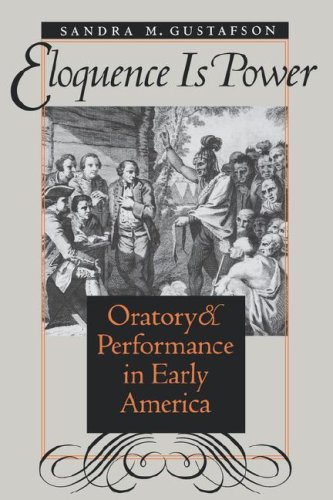
A book by Sandra M. Gustafson (University of North Carolina Press, 2000), Eloquence Is Power: Oratory and Performance in Early America has something to say about one of our heroes:

A Revolutionary war veteran, Christian Indian, dedicated leader of his Mahican community, and preserver of Mahican traditions, Aupaumut envisioned his role as ambassador to the northwest Indian nations as an extension of ancient Mahican traditions of diplomacy. Negotiating on behalf of the "15 sachems of the United States," Aupaumut employed both written text and the oral forms of the treaty council with authority.

And here's a sample of a part of a June 20, 1791 speech that was later written down:

Brother,
I feel thankful that by the goodness of the Great Spirit above we have again brought our pipes together; that we may speak together in friendship. I feel glad that the father of the United States has appointed you to kindle this council fire for peace. - I have something to say to you which for a good while has lain with weight upon my mind.
Brother, Attend!
I will remind you that I, my nation have always been the true friends of the Americans. Even from the first day they entered into a covenant of friendship. I, my nation have never been unfaithful nor broken any part of the chain of friendship.
You can view that speech fragment online as part of the Papers of the War Department project. The curious thing about it is they call it a "Speech of Hendrick to Stockbridge Indian Chief," while Captain Hendrick was himself a Stockbridge Chief and his words were clearly meant for the ears of United States officials.

Friday, May 7, 2010

People of Nama'o

You already know that the Menominees are 'the people of the wild rice' (although there are some Wisconsin Indians who disagree). But according to a new book published by the Wisconsin Historical Society Press, the Menominees are also the "People of Nama'o." Nama'o means "sturgeon" in the Menominee language and "People of Nama'o" is chapter 6 of the new book, People of the Sturgeon:Wisconsin's Love Affair with an Ancient Fish. Mostly, it is a book about the modern-day white people who stand on the ice of Lake Winnebago with spears, waiting for a huge sturgeon to swim by.


For information about this photo, please see the Fish Geek blog.


But the prehistoric fish has been important to Menominee culture since prehistoric times.

According to page 176, the Menominees' "Fish Dance" mimics "the movements of the sturgeon as they travel up the river to spawn." (Pictured is David Grignon, the Menominee tribal historic preservation officer.)

Friday, April 30, 2010

Black Elk: The Controversy Continues

Michael Steltenkamp's second book recently received a bad review in the American Library Association's Choice Magazine.

Nicholas Black Elk: Medicine Man, Missionary, Mystic was panned by Colgate University's C.T. Vecsey as having much of the same content as his earlier book Black Elk. Furthermore, Vecsey questions Steltenkamp's objectivity, while appearing to side with authors like the poet, John Neihardt, who strike me as being quite subjective.

(In addition to being a Roman Catholic priest, Seltenkamp also has a PhD in anthropology.)

Vecsey criticized Steltenkamp for basing all of his research on his interaction with Lucy Looks Twice. I have to question this. As I see it, Steltenkamp carefully read Neihardt's book and was right to ask why the poet glossed over the last 40-50 years of Nicholas Black Elk's life.

If the review of Steltenkamp's current book was online I'd give you a link to it. However, I can give you a link to a site that looks at Black Elk in a way that is closer to how I tend to look at him. I especially encourage you to scroll down to the botton of the link and read the section under the heading

WHY IS BLACK ELK SO CONTROVERSIAL?

The person responsible for that site is Sam Wellman. Black Elk is one of his "Heroes of History," and I'm somewhat amused that the heroes he tends to focus on are "explorers," and "missionaries." These, as you may know, are two of the most-bashed occupations amongst historians.

Friday, April 9, 2010

Roger Williams and the Naragansetts


The American Indian Studies Program at Cal State University has done us the service of creating "Indians of North America - The Native American Experience." Their collection of historical images features a few that are relevant to Algonkian Church History.

The Naragansett name has come up in my previous posts because some of the genetic makeup of the Stockbridge and especially the Brothertown Indians comes from the Naragansett Nation.

Here is Cal Tech's description of the above engraving (property of the Library of Congress):

London-born Roger Williams (c.1603-1683) was an American Puritan leader and founder of Rhode Island. Banished from Massachusetts in 1636 for his separatist ideas, he set out with a few followers and went to Rhode Island. There he befriended the Narragansett Indians and bought land from them to settle on, naming the town Providence. Williams firmly believed in treating the Indians justly and humanely; he encouraged his fellow colonists to pay the Indians fairly for their land. In 1643, he published a dictionary of the Algonquian language, an endeavor which helped further friendly relations between the settlers and the Narragansetts. Providence
became a safe haven for many people, among them Quakers, Baptists, and Jews, who fled the religious persecution of the New England settlements.

Tuesday, March 30, 2010

An Indian Land Case in the Colony of New York, part 3 of 3

*Read part 1 of this series*
*Read part 2 of this series*

Henry Moore (below) was the Royal Governor of the Colony of New York from 1765 to 1769.

The remainder of Patrick Frazier's thirteenth chapter in The Mohicans of Stockbridge is impossible to summarize in the space of one blogpost. As is often the case, his research turns up a lot of details that can hardly be called insignificant. Nevertheless, for those of you who won't be reading Frazier's book soon, here's what happened next:

The four Stockbridge chiefs returned to the colony of Massachusetts full of optimism after having been treated so well in London. They were told that the earl of Shelburne would send instructions on their case to New York's Governor, Henry Moore, and there is no reason to doubt that those instructions were sent. On the other hand, Governor Moore's willingness to heed those instructions is another matter. It appears that just too much was riding on the case - I mean that Moore's cronies had a lot to lose if he ruled in favor of the Indians. For that reason he apparently managed to ignore any pressure that may have been applied from London.

Here's how the case was resolved according to Patrick Frazier (page 169):

At the end, Governor Moore asked [Wappinger Chief Daniel] Nimham's counsel if they thought they had had a fair trial. The lawyers avoided answering directly. The 'several exceptions' they had taken to the [contested] deed were, in their minds, rather fundamental legal points. Moore closed the proceedings without rendering a final decision. A few days later the decision suddenly appeared in the public press. The governor and the council declared that the [land] patent was good and the purchase valid, that the Wappingers had no right to the land, and that they had been induced to complain by squatters who wanted support for their own claims. The Wappingers' complaint was "vexatious and unjust, and...accordingly dismissed.
This decision was not only a shock to the Indians but it was also a shock to their schoolteacher, Timothy Woodbridge, who wrote a number of letters in a futile attempt to advocate for the Indians.

*-----*-----*-----*-----*-----*-----*-----*-----*-----*
A contemporary account of this "Indian Land Case" exists. Learn about it from this post.

Friday, March 19, 2010

Stockbridge Indians Appeal to the King

The Hudson Valley Land Case as told by Patrick Frazier, Part 2


The 13th chapter of Patrick Frazier's The Mohicans of Stockbridge (pages 160-171) is called "Learning the King's Limitations." It begins with our Indian heroes of Stockbridge, Massachusetts - the Wappinger Chief Daniel Nimham, as well as the Mohican patriarchs Jacob Cheeksaunkun (believed to be the father of the Chicks family), Solomon Uhhaunauwaunmut (the father of Hendrick Aupaumut and the Hendricks family), and John Naunauphtaunk - striking a deal with "William Gregg, Jr., a well-to-do New Englander." Essentially, Gregg was paying the four Indians and their four wives to go to England, and paying them to reside there for three years while they appealed their land case (as discussed in the previous post) to the King. In return, Gregg would receive a twelve square-mile tract of land and, while in England, the three Mohicans (but not Chief Nimham) would "act as Gregg's servants" (page 160).

Below: The Salisbury Cathedral is just one of the remarkable sights seen by the delegation of eight Indians when they arrived in England in 1766.

Frazier's account of the visit - as you might imagine - is quite remarkable. Nevertheless, in the limited space I have, I'll stick to the appeal of the land case itself, the reason for the trip.

At the end of August [1766] the Lords of Trade reported their findings to the King, focusing on the Wappinger claim. In their opinion there were grounds for further investigation into the facts, especially since 'frauds and abuses in respect to Indian lands...have so notoriously prevailed and been complained of in the American colonies and in [the colony of New York] in particular' (page 163).
Frazier continues in the next paragraph:

The earl of Shelburne had taken [the Indians'] affairs under his wing. After consulting with the king, the earl informed the Indians that he would instruct Governor Moore to give their case serious consideration and to find a just and speedy solution.
My guess is that the delegation had hoped for more when they set off across the Atlantic. Nevertheless, the "Indian land case" was at least taken seriously in London and Daniel Nimham and the rest prepared to pursue the case with the Governor.

The Hudson Valley Land Case as told by Patrick Frazier, Part 1

Land conflicts (as well as military conflicts) were discussed at the Albany Congress of 1754. In this particular artist's conception, Benjamin Franklin appears to be ignoring the plea of a chief or is possibly just looking towards us because he is "easier to draw" that way.
In one of my first posts, I recommended that you read The Mohicans of Stockbridge, by Patrick Frazier. The book has merited mention in several posts since that time and needed to be kept out of my previous post so as not to upstage the remarkable document which is its topic. Having read that post, you're ready for a preview of that same legal case as told by Patrick Frazier on pages 155-170 of The Mohicans of Stockbridge.

The Highlands patent covered "about 200,000 acres" and Daniel Nimham's father and grandfather had "complained frequently to the patentee and his heirs about the patent"(page 155). In the wake of the Seven Years War (often called the "French and Indian War"), Chief Nimham, as you may know, moved his Wappinger remnant - roughly two hundred people - to Stockbridge, Massachusetts. Soon afterwards, the estate's heirs, Roger Morris, Beverly Robinson, and Philip Philipse, "asserted their claim and even extended it by nearly 5,000 acres" (pages 155-156). Sir William Johnson, an advocate for the Indians made appeals to the authorities which were "met with polite but evasive answers" (page 157).


Sir William Johnson ---->


However, a hearing was granted for the Indians before Lieutenant Governor Cadawaller Colden on March 5, 1765:

Daniel Nimham, speaking in English, presented the Wappinger claim to the territory based on the ancient tribal heritage. Then he interpreted the proceedings for the other Indians, while [Samuel] Munrow [a white ally of the Wappingers whose own self-interest was also at stake], and the representative of the patent heirs debated the issues. The Indians, somewhat intimidated by the imperious air of the council, were taken aback when Beverly Robinson produced a curious Indian deed for the area in question, dated 1702 and signed by several Indians. Although one of the old tribesmen recognized some of the names, he recollected no transaction that the deed described. Samuel Munrow was allowed to examine the deed only briefly, but he could see flaws and possible fraud even so.
Before they had to leave, Chief Nimham asked to hear a verdict from the Lieutenant Governor. Colden conferred with his council and declared the deed to be good and, Frazier also reports that Colden "told the Indians to trouble the government no more" (page 158).