Showing posts with label Other tribes/Other people. Show all posts

Thursday, November 7, 2013

Kid Lit about Native Americans: Rethinking Columbus and Other Titles

The latest issue of School Library Journal features a list of books for kids about American Indians.

It is a good thing that these books come from a variety of genres. Nevertheless, this blog is about history, so I won't tell you about any Native science fiction or other genres that aren't specifically about history. We'll stick to history here.

That leaves just two books, both of which are aimed at high school youth. The first one, with its lesson plans and attention to the educational process, might be aimed at teachers as much as it is at students.

Rethinking Columbus: The Next 500 Years, 2nd Edition
Bill Bigelow and Bob Peterson, editors.
The first edtion of this book made a big splash in 1991.
Oddly, the second edition (published in 2003) is not available on Amazon, but you can purchase it from Rethinking Schools.


The other book is good for teens but also a good read for adults:
 

Code Talker Stories by Laura Toho
The author's father, Benson Toho was a code talker and the book is based on interviews with the surviving code talkers. Includes photos by Debra O'Grady.
Available at Treasure Chest Books

Friday, September 27, 2013

Battle of the Thames Bicentennial:Tenskwatawa, Tecumseh and Harrison Struggle over the Old Northwest

October 5th, 2013 marks the bicentennial of the Battle of the Thames. In a series of posts on this blog you may have already read how the Shawnee Indian Lalawethika became a prophet and how he rose to prominence among the more anti-American Indians in the Old Northwest, first by officiating in a witch purge and later by predicting a solar eclipse. White people at the time and historians until recently have thought of the Native resistance movement as being a primarily political one led by the prophet’s brother, Tecumseh. However, in recent years, historians like Alfred Cave and Adam Jortner are putting Tecumseh’s brother front and center. Their research indicates that the Native resistance movement or city-state if-you-will was primarily religious or spiritual in nature – at least up until 1809 when William Henry Harrison’s aggressive conduct forced the Indians to defend their territory. But until then the movement was led by Tecumseh’s brother, Tenskwatawa, alias Lalawethika.

Let’s pick up the story after Lalawethika successfully predicted the solar eclipse of June 16, 1806. His followers had already established a town near the remains of Fort Greenville in Ohio, but the prophet asserted that the Master of Life – his name for the Great Spirit - told him to construct a new settlement in present-day Indiana. The move was made in 1808. At roughly the same time as his base of operations moved from Greenville to Prophetstown, Lalawethika changed his name to Tenskwatawa. Historian Adam Jortner doesn’t doubt that the Shawnee prophet was motivated by religion. At the same time, Jortner (114) observes that Prophetstown, at the confluence of the Wabash and another river that whites mispronounced as “Tippecanoe,” was ideally located from a secular viewpoint. By moving from Ohio, to Indiana Territory, Tenskwatawa was moving onto William Henry Harrison’s turf; Harrison was the governor of Indiana Territory. Harrison had denounced the prophet after he put four Delaware Indians to death in the witch purge of 1806, but the two men got together soon after Prophetstown was established and Harrison actually took a liking to Tenskwatawa.

However, Harrison was more concerned about his career than with making friends with Indians. He used a number of shady tactics to effect the 1809 treaty of Fort Wayne, in which three million acres was ceded to the United States by Miami, Delaware, Shawnee, Kickapoo and Potawatomie chiefs (Jortner, 160-164). Harrison had recognized the local chiefs as owners of the land and that was precisely what Tenskwatawa and his followers objected to. As they saw it, Harrison was taking advantage of Indians by bargaining with local chiefs. The all-Indian confederacy they were building was intended to force the United States to deal with all the tribes collectively, rather than allowing them to play tribes against each other. So Harrison’s Fort Wayne treaty of 1809 was the thing that turned Prophetstown from a primarily religious or spiritual movement or city-state into a primarily political and military one. Tenskwatawa threatened to not allow the United States to survey the 1809 treaty lands and in 1810, his brother Tecumseh personally threatened Harrison that the movement would ally with the British if the treaty wasn’t nullified (Langguth, 167). In November, 1811 Harrison brought a thousand soldiers to Prophetstown and the result was the Battle of Tippecanoe. With about sixty men dying on each side, it wasn’t the rout that Harrison’s supporters later claimed.

At this point Harrison’s political opponents in Washington launched an investigation. In an earlier post, I explained historian Adam Jortner’s research about how William Henry Harrison got away with his belligerent conduct towards the Indians of the Old Northwest. To make a long story short, there were already tensions with Britain and a common, but erroneous, belief that the British were a bad influence on the Indians. So Harrison got away with his aggressive tactics by making them just one part of the push for war.

Tecumseh and his warriors teamed up with the British forces. In taking Fort Detroit, they declared all of Michigan Territory theirs. However, within a few months, the British supply chain was cut off due to Admiral Oliver Hazard Perry’s naval victory on Lake Erie. This prompted the British General Henry Proctor to plan a retreat. When Tecumseh got word of Proctor’s plans he was outraged and made a valiant speech. After a few days the two leaders came to a compromise: they would only retreat to the nearest defensible location. That was the Thames River. That retreat meant giving up Michigan and many of Tecumseh’s warriors – who were fighting specifically for Michigan - left at that point.

When the Battle of the Thames started, Tecumseh’s forces were on high ground overlooking a swamp and the British were somewhat protected by the river. In what Canada’s Battle of the Thames Bicentennial website calls a “bold and unconventional move,” Harrison unleashed his cavalry on the British, who - being outnumbered and unmotivated - spared their own lives by surrendering or fleeing. Tecumseh and many of his most militant warriors, fought to the death, however, in a decisive victory for the United States.

Although Tenskwatawa fled into Canada, the Battle of the Thames did not put an end to his movement as many have believed. As of 1816, he still had a large following of warriors. But when many of them decided to rebuild Prophetstown, he was afraid to go back with them (Cave, 138). He later worked out a deal with the United States and died in a Shawnee community in present-day Kansas in 1836.

References

Cave, Alfred A. Prophets of the Great Spirit: Native American Revitalization Movements in Eastern North America. Lincoln: University of Nebraska Press, 2006.

Jortner, Adam Joseph. The Gods of Prophetstown: The Battle of Tippecanoe and the Holy War for the American Frontier. Oxford: Oxford University Press, 2012.

Jortner, Adam Joseph. The Gods of Prophetstown, online interview: http://www.amazon.com/The-Gods-Prophetstown-Tippecanoe-American/dp/0199765294 accessed on 8/23/2012.

Langguth, A. J. Union 1812: The Americans Who Fought the Second War of Independence. New York: Simon & Schuster, 2006.

Thursday, September 12, 2013

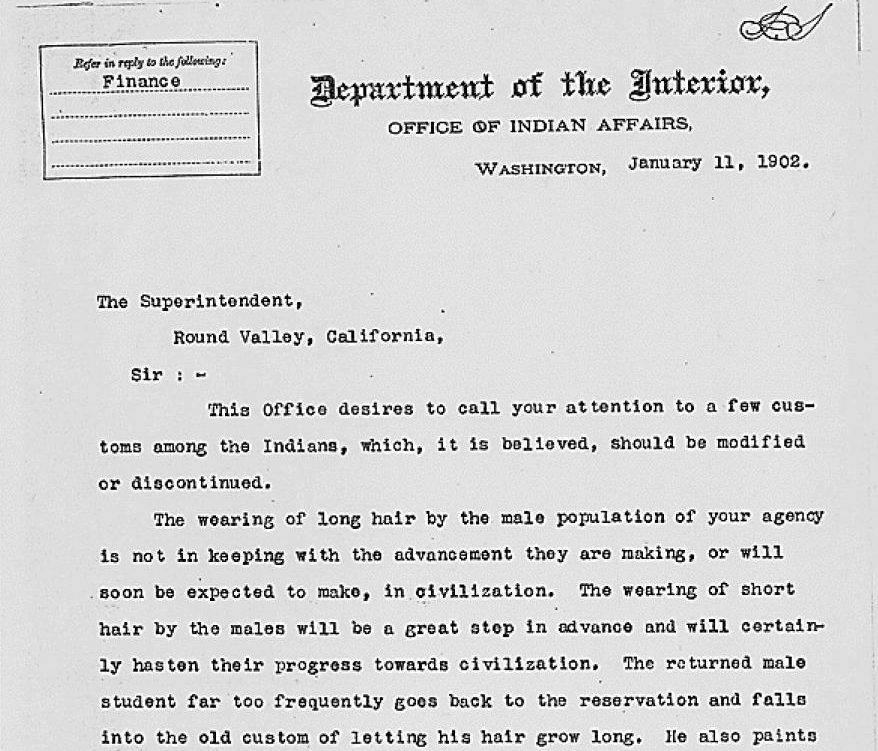
Is Short Hair More "Civilized"? (The U.S. Government Thought So)

What does it mean to be "civilized"? It is a question we no longer ask today because we've become sensitive to what happens when one group of people - a group that assumes their ways are better - interferes with another group and tells them what to do. But the word "civilized" was still being used in United States government documents at the beginning of the last century.
This comes from Slate's historical blog, The Vault In case you cannot read the small text, here is a transcript:
This Office desires to call your attention to a few customs among the Indians, which, it is believed, should be modified or discontinued. The wearing of long hair by the male population of your agency is not in keeping with the advancement they are making or will soon be expected to make, in civilization. The returned male student far too frequently goes back to his reservation and falls into the the old custom of letting his hair grow long....
The letter continues for another page and a half, if you find it outrageous or outrageously quaint, you may want to read the post that goes with it.

Thursday, July 11, 2013

American Indian Gothic


Have you seen American Indian Gothic before?

It is part of the Smithsonian art collection and when you find it online it comes with this important information:

Tuesday, April 16, 2013

The Atlas of Great Lakes Indian History


It can be a lot easier to learn history if maps are avaliable.  That is a central premise of a book that can be very helpful to anybody trying to understand Indian history in the Great Lakes states and Ontario, Canada.  The Atlas of Great Lakes Indian History was edited by Helen Hornbeck Tanner and the Cartography is by Miklos Pinther.  It is far from just a book full of maps.  Instead, maps illustrate the text.  The two formats complement each other very nicely.

If you want to locate an Indian village in one of the Great Lakes states, this book is the place to look (see especially pages 88-89).  If you want a clear understanding of the Blackhawk War, the map and text provided (151-154) might be the best place to start.  For most peole it will be as much as they need to know. I doubt there is a better source for getting an understanding of "the frontier in transition" for this part of the country.  Tanner and Pinther have done us a great service.

Here's an example of one of the maps (click on it to get a better veiw):


Friday, April 12, 2013

Carlisle Fools Harvard: The Hidden Ball Trick

Pictured above is Jim Thorpe, known as the greatest athlete of all time.  He played football for the Carlisle Indians before going on to professional football.  However, most of Carlisle's players were not as big and powerful as Thorpe.  The average weight of the players on Glen "Pop" Warner's teams was about 170 pounds.  They were smaller than the college teams they played against.  And they made up for it with speed, deception, and tricky plays, the most famous of which was the "hunchback" or "hidden ball play."

A number of years before Jim Thorpe came to Carlisle, the team's quarterback was an All-American named Jimmie Johnson.  Johnson was a Stockbridge Mohican.  Under Johnson's leadership, Carlisle pulled off one of the most remarkable trick plays in all of sport.  And it happened during a game against the arrogant Harvard Crimson.  It was a home game for Harvard but the Carlisle Indians duped the Harvard players so badly that the fans were laughing at the home team's obliviousness.

The game and the play that I'm talking about is featured in Sally Jenkins' book, The Real All-Americans.  Fortunately for us, the chapter is already online, thanks to NPR books

After Carlisle, Jimmie Johnson continued his education and became a dentist.  He also continued playing football at Northwestern University.  (They didn't have strict eligibility rules back then in college sports.)  A special tribute to Jimmie Johnson was created by an unoffical website of Northwestern Football.

Wednesday, January 30, 2013

The Many Trails Symbol and a pdf about the "Folk Art" of Wisconsin Indians

Richard March of the Wisconsin Arts Board (now retired) developed an apprenticeship progran in the mid-1980's that facitated the process of passing along traditional skills also known as folk art.

March and Janet Gilmore proceeded to develop what might be called a pamphlet, now accessible online as a pdf.  The full title is

WOODLAND WAYS: Folk Arts Apprenticeships Among Wisconsin Indians 1983-1993


This blog tends to focus on the Stockbridge Mohicans and the creator of that tribe's "Many Trails" symbol, Edwin Martin, is one of the featured artists.


If you're a Stockbridge Mohican, you already know that the Many Trails symbol has been reproduced in pendants, rings and earrings. (In my web searches for a good pic of the Many Trails symbol I've also seen it as a large tattoo on a woman's back.)  These were depicted in Woodland Ways:


Here's Martin's description of the symbol that he created:
The design symbolizes the endurance, strength, and hope of a long-suffering, proud, and determined people.  The curved shape represents the arms of a man raised in prayer.  the circles represent many campfires.  The lines represent the many trails taken from the time the Indians left their ancestral homes.


There are also a lot of other good artists featured in the Woodland Ways pdf:


Wednesday, January 9, 2013

Appenoose Declines Mission Opportunity


It may come as a surprise to many, but the Stockbridge Mohicans were such devout Christians that they initiated a mission trip to their fellow Algonkians, the Sauk and Fox (aka Sac and Fox) Indians.  At that time, 1834, the Sauk and Fox Indians were living in Iowa and along the western edge of northern Illinois.  Due to their lack of funds, the Stockbridge Mohicans asked the mission society that supported their church, the ABCFM (American Board of Commissioners for Foreign Missions) to help pay for the trip.  They also asked if a missionary could accompany them.  

Not surprisingly, the ABCFM liked the idea and they instructed the Stockbridges' missionary, Cutting Marsh, to make the trip.  The Stockbridges were living at Statesburg back then (present-day Kaukauna, Wisconsin), so the delegation took a birch-bark canoe up the Fox River, then portaged onto the Wisconsin River which they took down to the Mississippi.  From there they traveled by steamboat, horse and maybe again by canoe.

The record we have of the mission trip comes from Cutting Marsh's journals.  He unfortunately didn't have much to say about the four Stockbridge Mohicans that traveled with him.  Nevertheless, Marsh's descriptions make for a rather good read.

Even better - I think - is the summary of the trip written by Marsh's biographer, Roger Nichols.  Nichols' re-telling of Marsh's attempts to get the Sauk Chief Appenoose to bring Christianity and "civilization" to his people is worth quoting at length.

After a week, Appenoose agreed to confer with [Marsh] on August 7.  They had already talked informally about the possibility of establishing a school or mission, and the chief seemed interested.  His apparent cooperation caused Marsh to become very optimistic, but their planned meeting was never held.  That afternoon an Indian trader brought several kegs of whiskey to the village and in a few hours all was badlam.  The chief, as well as most of the tribe became drunk and Marsh lost this opportunity.  He retired early, complained bitterly about the lack of dependability among the Indians, and blamed the white men who brought whiskey to the village.....

The following morning Marsh and Appenoose conferred about the establishment of a school at the village.  They were unable to reach an agreement, partly because the chief was suffering from the effects of his drunken spree.....the Indians managed to treat Marsh with some courtesy and still, in effect, refuse his offer.
Nichols tells us that Marsh did some preaching and persuading over the next two days but made little headway and, feeling sorry for himself, he went into the woods to be alone.  Nichols continues:

While [Marsh] was gone the traders brought another canoe with whiskey, and the merriment began again.  Marsh was disgusted by the drunken revelry and savage yelling in the village, and remained away until late in the evening.  

Tuesday, November 6, 2012

Everything You Wanted to Know About Indians - Anton Treuer's New Book

Wow!  I really would be afraid to ask a lot of the questions that make up the headings of Anton Treuer's new book.  Here's a sample:

Why do Indians have long hair?
Why does getting the Columbus story right matter?
What is blood quantum, what is tribal enrollment, and how are they related?
What is Indian religion?


Treuer doesn't make the claim that he can speak for all Indians. Instead, his contacts with people from other tribes give the reader an idea of the diversity of Indigenous peoples in this hemisphere.

Here's an excerpt that shows Treuer's expertise and also his willingness to "tell it like it is":
What is "Indian Time"?
Indian time is...a terrible misconception widely held in Indian Country. Today the concept is used as an excuse to be late or lazy.  But Native Americans in former times were neither. If you woke up late or took a lazy day your children often went hungry. People worked hard and were physically fit to in order to survive. [from page 46]

Buy Everything You Wanted to Know About Indians But were Afraid to Ask from the Minnesota Historical Society.

Friday, September 28, 2012

Oneida Language Resource from UW Digital Collections


The Wisconsin Oneida Language Preservation Project is part of the University of Wisconsin's Digital Collections.

Contents include a K - 6 curriculum, songs, and stories told and recorded as part of the WPA or Works Progress Administration program during the New Deal era.


Don't forget, Oneida is an Iroquois language, closely related to the languages of the Seneca, Tuscarora, Onandaga, Cayuga and Mohawk Indians.

Friday, August 24, 2012

ACH Centennial Edition: The War of 1812 - Part I

This engraving, taken from Encyclopedia Brittanica Online depicts the Battle of the Thames, a decisive victory for the United States over the British and Tecumseh. (Please click on the image, it looks a lot better when enlarged.)

Congress was investigating William Henry Harrison for his aggressive tactics towards the Shawnee brothers and their city-state of Prophetstown at the same time that there was tension with Great Britain.  One of the issues was that the Canadian border had not been determined and some politicians wanted to conquer the British-owned territory to the north. 

According to historian and author Adam Jortner, the investigation being conducted on Harrison - then the governor of Indiana Territory - was something of an historical turning point.  United States officials tended to blame the British for stirring the pot with Indians (when actually it was people like Harrison who stirred it, but that is fodder for another blogpost).  Anyway, Harrison's political opponents were upset with his conduct towards the Indians, but another rather powerful political faction, known as the War Hawks or "young War Hawks," was so intent on building up reasons to go to war against the British that the report on the investigation of Harrison wound up not being about Harrison's actions per se, but instead about how he was reacting to a nasty conspiracy between the British and the Indians of the Old Northwest.

As Jortner put it in an online interview [to read it you'll have to "scroll down" after you get to the amazon page], William Henry Harrison saved himself by joining the "push for a broader war against all the Northwest Indians and Canada."  The War of 1812 was declared just five days after Congress made their report on the investigation of Governor Harrison.  

Tuesday, July 24, 2012

What was Captain Hendrick's Role in the Western Expansion of the United States?

In researching the life of Captain Hendrick Aupaumut, chief of the Stockbridge Mohicans and also an official of the United States government, I've had to accept that there are a lot of grey areas and a lot of blanks that will never be filled in. I have no doubt that he was "a man of integrity," fighting for what he believed in.  The historians that called him "befuddled" or a "stooge" for the United States must have been missing something.

Then again, Captain Hendrick helped facilitate treaties in Ohio and Indiana that turned Indian land over to the US government.  My thinking is that he knew that there would be white expansion and believed that tribes would continue to lose their land and suffer until they adopted Christianity and "civilization."  This is pretty much the same as what you will read in the three scholarly articles written about him (see below for citation), so I thank James and Jeanne Ronda, Alan Taylor, and Rachel Wheeler for their work on this topic.

My recent posts about the White River Delawares and Tenskawatawa, the Shawnee Prophet, are the context in which Captain Hendrick worked.  President Jefferson's administration hired Captain Hendrick to serve as the Delawares' "Civilizing Agent" from 1809 until the War of 1812 temporarily forced them to a safer location.  During that time he did what he could to stop the Shawnee Prophet's movement and John Sergeant (Jr.), the Stockbridges' missionary, gave him credit for doing exactly that:
“through the judicious arrangements of Capt. Hendrick, the influence of the Prophet is nearly at an end.” 
That statement was preserved for us in a book written by Electa Jones of Stockbridge, Massachusetts, printed in 1854.  Unfortunately, Jones doesn't say when John Sergeant made that statement, making it more difficult to prove its relevance in the course of American history.

We do know that Tenskwatawa, the Prophet, became less important between 1809 and 1813.  Until recently the showdown over western expansion of the United States that was going on was seen as a battle personified by the conflict between William Henry Harrison and Tecumseh.  But current historians recognize that Tecumseh didn't become important in his brother's movement until it became political. 

Will Captain Hendrick someday also be recognized in the same way that historians remember Harrison and the Shawnee brothers?  I think that is unlikely.  There are just too many grey areas and too many blanks that will never be filled in.


Sources:

Ronda, James and Jeanne. "'As They Were Faithful': Chief Hendrick Aupaumut and the Struggle for Stockbridge Survival, 1757-1830," American Indian Culture and Research Journal, 3, 1979: 43-55.

Taylor, Alan. Captain Hendrick Auapaumut: The Dilemmas of an Intercultural Broker,"  Ethnohistory, Summer, 1996.

Wheeler, Rachel.  "Hendrick Aupaumut, Christian-Mahican Prophet,"
Journal of the Early Republic; Summer 2005, Vol. 25 Issue 2, p187

Thursday, June 21, 2012

The Gods of Prophetstown - with Comments from the Author

In a recent post, I told about the Delaware witch purge of 1806.  This witch hunt/purge is the topic of one chapter of a new book by University of Auburn history professor Adam Jortner.  The full title is The Gods of Prophetstown: The Battle of Tippecanoe and the Holy War for the American Frontier.

Essentially the book contrasts William Henry Harrison - as a Deist - with Tenskwatawa, the Shawnee Prophet.  I think it tells the story very well and corrects a number of assumptions made by historians in the past.  One of those assumptions had to do with witchcraft; and in particular, the "role" it might play in a community.  In the past, historians have asserted that witch hunts allow a comunity to set boundaries of appropriate behavior or somehow aid in conflict resolution, but Adam Jortner doesn't buy it.  In an e-mail to me he said:

[I]f religious ideas only have social functions, then religion basically *is* sociology, when you get down to it, and although religion has many social functions, I don't think it's ALL social functions.
So I don't think the witch hunt had a "role." I think the Delawares...had fears about witches, and the purpose of the hunt was to initiate a supernatural war against them. I think Tenskwatawa was invited because of his presumed supernatural powers, and while he benefitted politically from the event, I don't think he manipulated the proceedings--I think he also was concerned about witches.
In my opinion, the witch hunts aren't a front for something else--they are just hunts for witches.
I get the impression from reading the book that Adam Jortner, on the one hand, has a lot of respect for religion, but, on the other hand, he doesn't study religion per se.  What he studies is people's religious beliefs that make up the contents of American history.

I feature lots of books on this blog that I don't (explicitly) recommend to you, the reader.  Unfortunately, lots of books written by history professors don't make for good reads for those of us who aren't history professors.  I think The Gods of Prophetstown is an exception.  It is more readable than the vast majority of books of its kind.

See the book review and author interview in Indian Country Today magazine.

Thursday, May 24, 2012

The Delaware Witch Purge of 1806

Above:  An artist's conception of the Purge of 1806.  The Shawnee Prophet, later known as Tenskwatawa,is depicted second from right (the rightmost "fully drawn" person). 

After Beata withdrew her witch-finding services, the White River Delawares brought in an emerging spiritual leader from the Shawnee tribe.  The man's name was Lalawethika.  He'd been an alcoholic and his face was deformed from a hunting accident, but in May of 1805 he went into a trance and experienced a vision, which convinced him to stop drinking and started his career as a prophet in much the same way as the careers of other Native prophets began.

The Shawnee prophet arrived at White River on March 15, 1806.  Those accused of witchcraft were brought before him and he performed ceremonies before passing judgement.  Outwardly, Lalawethika made a big deal about being against aspects of traditional Algonkian religion, but the victims of the 1806 purge were the more acculturated Indians; they may have either been Christians or had done business with the United States.

Confessions were induced through torture.  An old woman named Coltos, aka Anne Charity was the first to confess her guilt and was put to death.  Then the elderly chief Tetepachsit met the same fate, and the Moravian missionaries witnessed his body being burned.  Tetepachsit's nephew Billy Patterson is said to have died "Bible in hand, praying, chanting hymns, and defying the power of evil until his voice was stifled" (Cave quotes Jacob Dunn's True Indian Stories 1909, page 67, but appears to doubt the accuracy of the statement).  Finally Joshua, the Moravians interpreter, was also executed.

Another round of excecutions was set to take place on April 9th.  The first of eight accused Indians was the last surviving chief, Hockingpompsga.  But this time, as the executioners put their hands on the old chief; his friends grabbed their weapons and put a stop to the killings.


Sources:

Cave, Alfred (2006) Prophets of the Great Spirit pages 81-85.

Miller, Jay.  "The 1806 Purge among the Indiana Delaware: Sorcery, Gender, Boundaries and Legitimacy"  Ethnohistory, Spring, 1994 pages 246-266.

Thursday, April 12, 2012

Alfred Cave Describes Handsome Lake's 2nd Vision

Alfred Cave's Prophets of the Great Spirit: Native American Revitalization Movements in Eastern North America is a remarkable book. I also found it to be readable.

According to Cave, Native Prophets transformed their communities and essentially created new religions that were somewhere between their tribe's traditional religion and Christianity. Each prophet was unique, of course, but - in the Indian way - their movements began with some kind of a vision.

Of particular interest for me was Cave's description of the Seneca Prophet, Handsome Lake. It was Handsome Lake's second vision that became "the core of the new religion's theology" (page 195).
The vision came to Handsome Lake when he was in the midst of a deep trance that lasted seven hours. Here is what happened in the vision (all from page 195):

1. The Milky Way descended from heaven and Handsome Lake and his guide walked up it.
2. They passed a jail and saw handcuffs, a whip and a hangman's rope inside, symbolizing the severity of the white man's law.
3. A church with no doors or windows was very hot inside and the people confined to it were "crying in distress."
4. Further up the road "they met Jesus, who showed them the nail scars in his hands and feet and his bloody spear wound. Whites did this to me, Jesus cried, and then warned Handsome Lake that Indians must not trust white people."

There is a lot more in Cave's book about Handsome Lake and about many other prophets.


Friday, February 10, 2012

Commuck's Indian Melodies


In routine searches for data about the Brothertown Indians an item known as Indian Melodies by Thomas Commuck (himself a Brothertown), had flashed on my computer screen before but I'd not paid any attention to it until recently after Myron Paine sent it to me in digitized format.

One of the melodies caught my interest:


The fine print on the bottom reads:


The Narragansett Indians have a tradition that the following tune was heard in the air by them, and other tribes bordering on the Atlantic coast many years before the arrival of the whites in America; and on their first visiting a church in Plymouth colony after the settlement of that place by the whites, the same tune was sung while performing divine service, and the Indians knew it as well as the whites. The tune is preserved among them to this day and is sung to the words here set.
Commuck himself had what we might call a "scientific" mind and doesn't actually assert that the Narragansett tradition is a proven fact. Perhaps the Indians and the whites really did have melodies that were similar enough to claim that they were one and the same. I'd be interested in getting some feedback on that idea from a musicologist or cultural anthropologist.

No matter how you look at it, people of different races do have a lot in common. One possible take-away from the story is that the Narragansetts - despite their decimation during King Philip's War - managed to maintain some of their pre-contact identity, even if their memory of that identity has human imperfections. The story that claims the two races had something in common musically might have made living in a "white man's world" a little less unpleasant.

Monday, December 5, 2011

Leif Erikson and the Possibility of Christianity in America circa 1000 A.D.

This statue of Lief Erikson is located near the state capitol building in St. Paul, Minnesota.

Thanks to my recent posts about the Walum Olum, Algonkian Church History has a new set of readers. If I understand their views correctly, it appears they claim that the Lenape Indians became Christians during one of the voyages of Leif Erikson (or possibly during a visit from other Norse Greenlanders). Although the Walum Olum supports such a belief, the Walum Olum wasn't written before the 1700's so we'll have to look at other sources.

Two primary sources tell us about Lief Erikson: The Saga of Erik the Red and The Saga of the Greenlanders.

According to chapter 5 of The Saga of Erik the Red (see this English translation) Leif Erikson was sent by Norway's King Olaf to take Christianity to Greenland. Later, in chapter 11, the Greenlanders come upon people paddling "hide-canoes." It strikes me that these people are much more likely to have been Inuit [Eskimos] than Lenape. And nowhere is it claimed that issues of religion were discussed.

I wasn't able to find a translation of The Saga of the Greenlanders on the web. According to various sources, this saga includes some description not only of Leif Erikson's voyages, but also those of his two brothers, his sister, and a man named Thorfinn Karlsefni. I have not found any discussion of The Saga of the Greenlanders which claims that any of the voyages were used to bring Christianity to the Native Americans, instead I'll wait for my readers to contribute that evidence.


It seems so far that the evidence for Christianity on Turtle Island in "pre-Columbian" times is rather flimsy. Using the two sagas as their guides, scholars have tried their best to identify the location of the Viking settlement known as Vinland, but, according to the Dictionary of Canadian Biography,


It must be said that both sagas are too vague, too confused, and too brief in their accounts of the course followed by the Icelanders to Vinland, of the geographical and topographical features, of the flora and fauna, and so on, to enable positive identification. Even the passage in the Saga of the Greenlanders on the length of day in Vinland, which at first sight would seem very helpful, has proved a broken reed. Its interpretation involves highly technical definitions and astronomical calculations, leading to such great diversity of opinion that, on the basis of the passage, Vinland has been located as far north as 58°26´N and as far south as 31°N, or even Florida. Each scholar has had to juggle the narratives, assume copyists’ errors, supply missing details, and so on, in order to make his favourite locality fit the meagre details the sagas provide. By such means Vinland has been located as far south as Florida, as far north as Hudson Bay (where the climate is assumed without evidence to have been much warmer in the year 1000 than at present) and as far inland as the Great Lakes. Helge Ingstad has even suggested that there existed a North and South Vinland, the latter on the New England coast and the former in Newfoundland.
So without knowing where Vinland was, I think it would be difficult to claim that a particular tribe or Native nation was brought to the Christian religion by Norwegian explorers.


Tuesday, November 1, 2011

ACH Book Recommendation: Chief Bender's Burden by Tom Swift

Even if you are a baseball fan, you might not have heard of Charles Albert "Chief" Bender. In fact, I doubt that many of today's baseball fans know much about the so-called "deadball era."

In those days, Connie Mack's Philadelphia Athletics (or "A's") were regular participants in the World Series. The team featured the then-famous $100,000 infield (a lot of money to pay four players back then) and two Hall of Fame pitchers, Eddie Plank and "Chief" Bender, a White Earth Anishinaabeg from Minnesota.

Strip away the baseball content from this book and you have pretty much the same theme as Algonkian Church History: Indians denied their native ways took on white ways - and, for the most part, they succeeded in doing so. On the other hand, the title: Chief Bender's Burden: The Silent Struggle of a Baseball Star is spot-on.

Tom Swift researched Bender's life carefully and found that he volunteered to attend Carlisle. As you may know, there were times when Indian children were rounded up and forced to leave their parents. But after finishing up at one boarding school, Charles Albert ran away from home and was glad to see the "recruiters" from Carlisle. Unfortunately, Bender went to boarding school willingly after literally getting kicked by his father (who, I should probably mention, was white). Whatever role Bender's mother had in his upbringing was pretty much summed up by the fact that she didn't have much of a connection with Chalres Albert.

Later it was the manager and part owner of the Philadelphia A's, Connie Mack, who became a father figure to his young star pitcher. I enjoyed reading about some of the aspects of baseball then that are very different from how things are today. How did fans follow the scores back then? I'll give you a hint, they weren't sent to your Blackberry or reported on ESPN's Sportscenter, I'll let you get the real answer from the book.

Anyway, Swift pulled up a bunch of reports or stories about things that may or may not have happened. My favorite, if true, could have been the reason why 1914 was Bender's last season in an A's uniform:


[Mack] sent Bender, his bright pitcher with the eagle eyes, to New York to scout the Boston Braves. But, according to one version of the story, while Bender was supposedly in New York, Mack ran into him on a Philadelphia street corner.

"I thought you had gone to look over the Braves," Mack said.

Bender shrugged him off. "What's the use of wasting a perfectly good afternoon looking at a bunch of bush league hitters?" (page 209)
For more, see the book's page on the University of Nebraska Press' website.

You can buy the book and read several reviews at Amazon.com.

Monday, February 14, 2011

King Philip's War by Daniel Mandell

A map of New England in the "Praying Indians" era.


As one of its reviews on Amazon.com states, if you read one book about King Philip's War, it should be Daniel Mandell's. King Philip's War: Colonial Expansion, Native Resistance, and the End of Indian Sovereignty (published by Johns Hopkins in 2010) is both well-researched and readable.


As you might imagine, the thing about it that has interested me the most (so far) came under the heading "Christian Indians." Here are a couple brief excerpts:


The process by which many Wampanoags, Massachusetts, Nipmucs, and Pennacooks embraced the English God and culture was driven by the devasting epidemics and other massive changes to their world. Indians and Puritans similarly believed that the supernatural world worked in everyday occurrences, and both groups saw recent events as evidence that Jehovah had overcome the native gods and that survival required adoption of the English God. Roxbury minister John Eliot stepped into this psychic gap after learning the Massachusett language, preaching that Indians could find salvation by shedding heathenish ways and adopting Puritan disciplines in order to breathe the rarefied Calvinist air (pages 39-40).


...Native converts wore their hair like the English and forswore many old habits, from religious ceremonies, to body greasing, to demonstrate their ability to walk the Christian path of righteousness (page 40).


Mandell also writes of how the first 'praying town' of Natick came about through the partnership of John Eliot with Waban, head of the Massachusett village of Nonantum.

Friday, September 10, 2010

The Conversion of Fish Hawk

Bonnie Sue Lewis uses the conversion story of Fish Hawk, a Cayuse Indian, to illustrate the complexity involved in deciding to become a Christian Indian. (To get the whole story, you'll have to read Creating Christian Indians.) Like many other Indians, Fish Hawk made a deathbed conversion.

If Fish Hawk's conversion was like most people's stereotype of deathbed conversions, it would have been a superficial and/or cynical gesture, but this is clearly not the case. Instead, Fish Hawk experienced a vision; and it was his vision that led him to accept Christianity, but not the rest of white culture.